Design and Architecture
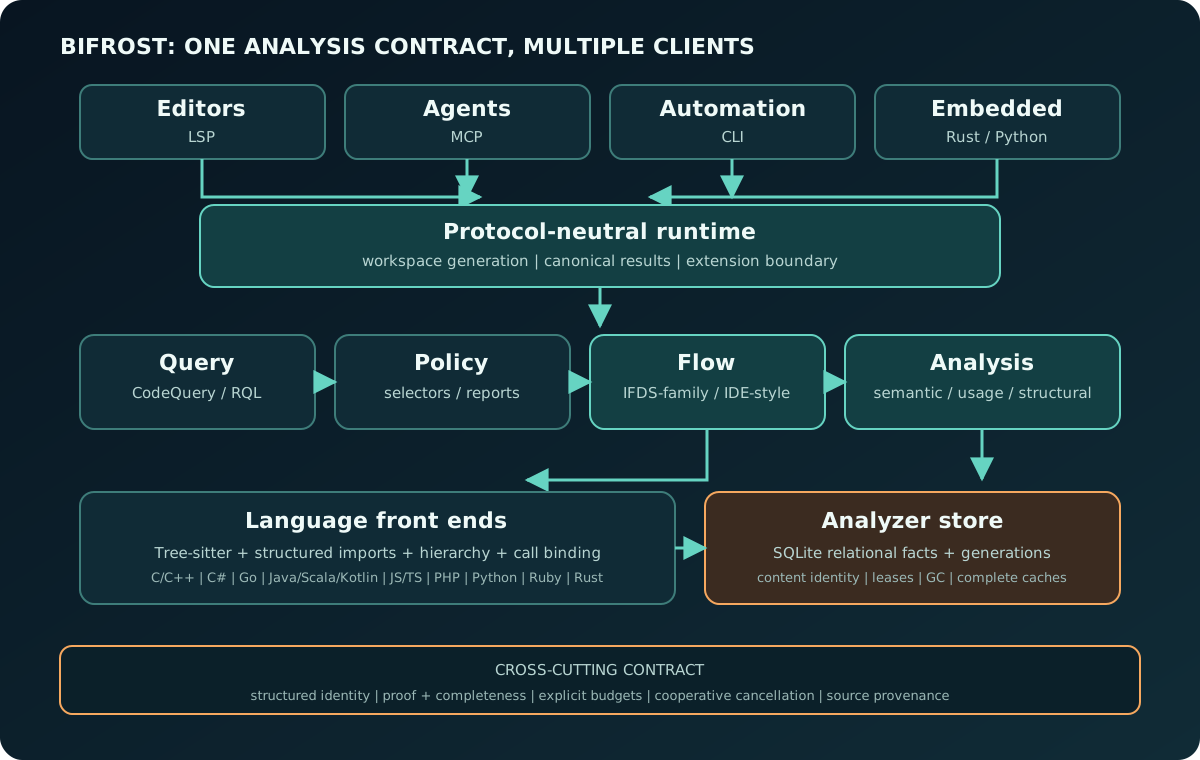
Bifrost provides interactive program analysis to editors, coding agents, automation, and embedded tools. Every result records its source evidence, proof status, analysis scope, and completeness. A missing result supports an absence claim only when the relevant analysis completed inside a stated boundary.
The design chapters describe how Bifrost is built and where its current
contracts end. Entries marked Direction or Research identify unshipped
work. The linked product docs cover API details.
Contents
Section titled “Contents”| Chapter | Central question |
|---|---|
| System Architecture | How do clients, runtimes, analyzers, and stores fit together? |
| Identity and Language Front Ends | How does Bifrost turn incomplete multi-language source into resolvable identities? |
| Storage and Cache Strategy | What is persisted, reused, invalidated, and recomputed? |
| Name Resolution Engine | How does a reference bind to its declaration across files, revisions, and build configurations? |
| Usage Analysis Engine | How are definitions, references, calls, and receiver-sensitive candidates connected? |
| Dataflow Engine | How do the bounded IFDS-family and IDE-style kernels power value flow, taint, and typestate? |
| Semantic Models and Summaries | How does external behavior participate while retaining its own provenance? |
| Evidence and Result Contract | When may a client claim that something is present, absent, or unresolved? |
| Decisions and Outlook | Which choices are settled, which are current directions, and what remains open? |
| Related Work | Which adjacent systems influenced the design, and where is Bifrost’s emphasis different? |
Representation lifetimes
Section titled “Representation lifetimes”Source-derived structural facts are durable. Semantic artifacts and graph projections are validity-keyed, and interprocedural analysis materializes only the region a request needs. Protocol adapters reuse the runtime’s analysis semantics.
See Representation lifetimes for the full table and Analysis storage layers for the persistence and reuse rules.
Status vocabulary
Section titled “Status vocabulary”Status labels distinguish shipped behavior from planned and open work:
- Current describes behavior present in the repository version documented by this site.
- Direction describes an intended design still under implementation.
- Research describes a question whose contract or engineering trade-off is still being evaluated.
The Decisions and Outlook chapter collects all Direction and Research entries. Each states its readiness conditions; roadmap labels carry no release dates.
Other documentation
Section titled “Other documentation”For user-visible behavior, start with Capabilities and Code Querying. Use Agent Result Safety to interpret a particular response, and Evidence and Evaluation Methodology to see what public tests and benchmarks establish.