Usage Analysis Engine
Usage analysis answers where a declaration is used. For each occurrence, it binds the occurrence to a declaration using the language’s resolution rules, records the evidence for that binding, and reports the scope that the request examined.
Bifrost uses those same rules for target-directed reference queries and bulk caller-to-callee graphs. An interactive lookup narrows toward its target. A bulk build processes admitted files and accumulates graph products.
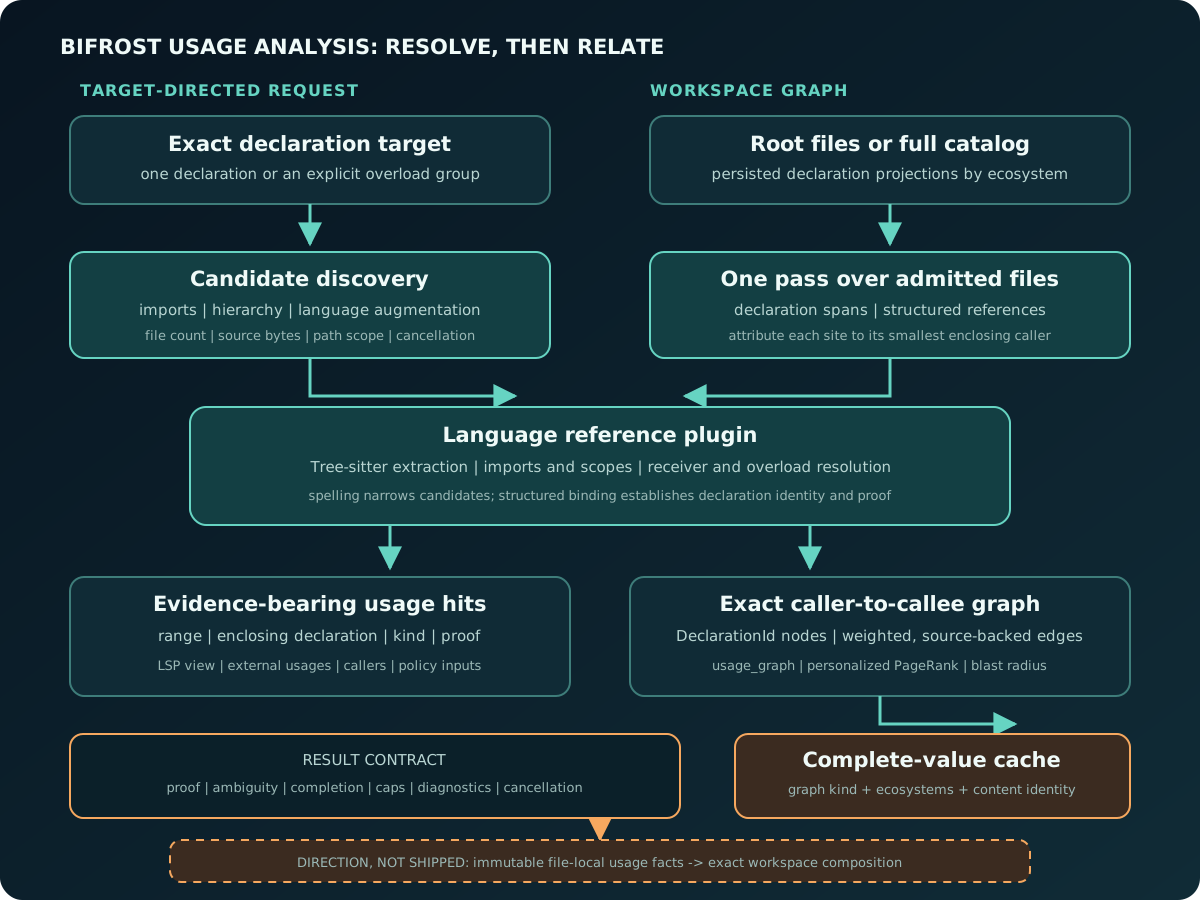
Reference queries and workspace graphs
Section titled “Reference queries and workspace graphs”| Workload | Starts from | Optimized for | Primary result |
|---|---|---|---|
| Target-directed references | One exact declaration or an explicit overload group | Editor references, agent navigation, callers, and focused policy work | Source hits grouped by target, with kind and proof |
| Workspace usage graph | Root files or the complete declaration catalog | Code maps, relevance ranking, blast radius, graph export, and bulk dead-code evidence | Exact declaration nodes and weighted caller-to-callee edges |
Target-directed pipeline
Section titled “Target-directed pipeline”1. Establish the target
Section titled “1. Establish the target”The public selector resolves before the reference engine starts. The engine
receives either a declaration-backed CodeUnit or a group of
declarations that one source reference may legitimately name. Overloads and
duplicate declarations remain separate candidates. The engine scans every
candidate and unions proven hits by source site. At a site where candidates
disagree on proof, it retains the proven reading.
Name collisions are common in vendored trees, generated/source pairs, overload sets, and multi-module workspaces. A reference stays visible when any candidate in the target group can prove it.
2. Discover candidate files
Section titled “2. Discover candidate files”Candidate discovery favors coverage because an omitted file can conceal a real reference. The generic path follows structured import reachability, includes the target’s defining context, and expands type hierarchies where polymorphism applies. A language plugin can add files required by its module, autoload, re-export, include, or visibility rules.
The request then applies its path and test-file scope. Independent file-count and source-byte limits control admission. When one limit forces truncation, core candidates are protected before supplemental expansion. Cancellation is checked throughout discovery and again during the file scan.
A budget is part of the request’s semantics. If it suppresses any file planned by discovery, the result is incomplete even when every admitted file was resolved exactly.
3. Extract structured sites and resolve them
Section titled “3. Extract structured sites and resolve them”The registry selects one reference plugin for the target’s language. That plugin owns language-specific meaning: imports, local bindings, namespaces, receiver types, inheritance, overload applicability, constructors, macros, and dynamic forms. Shared orchestration owns traversal, budgets, cancellation, and the common result contract.
Plugins begin with Tree-sitter structure and indexed declarations. Resolution succeeds when the language resolver binds a structured reference candidate to a declaration identity. A best-effort binding remains unproven, and an unsupported operation or missing graph seed produces a typed diagnostic.
Rust method searches may exclude ordinary field-access sites before resolving their receivers when source structure and provenance prove that those sites cannot name the method. Uncertainty about such a field’s binding does not make the method search incomplete. This exclusion does not apply to speculative macro input or malformed syntax, and it does not remove independent gaps in the original file inventory. Resolving a guessed macro argument to a field does not prove that its unrepresented expansion cannot call the method; that uncertainty remains visible. Qualified references to method values remain candidates even when they are not calls.
4. Publish hits with their roles
Section titled “4. Publish hits with their roles”A usage hit carries its file, byte range, line, enclosing declaration, reference classification, proof, and presentation snippet. It also carries a semantic role: ordinary reference, import, re-export, self receiver, declared-contract reference, definition, or override declaration.
Consumers select the roles appropriate to their surface. Editor find-references includes binding and self-reference sites for navigation; external usage, call-graph, and relevance surfaces omit them. Classification happens once, so every surface uses the same resolution rules.
Selected graph caller admission
Section titled “Selected graph caller admission”Native graph admission is separate from reference resolution. For every requested caller, the shared driver records either an admitted resolution unit or an explicit skipped classification. Admitted and skipped files are disjoint and together cover the exact requested caller set, including empty files. That evidence survives unit staging, projection, and graph aggregation; a skipped file does not erase the graph assembled from admitted callers.
The native Go graph covers the selected Go-tool profile. Its package-context
publication records IgnoredGoFiles as ignored-role package memberships. These
rows are evidence of deliberate build exclusion, never semantic candidates, unit
members, import sources, reverse-reference sites, or rename targets. A change to
this publication contract advances the Go context derivation version so retained
contexts acquire the new evidence.
Tool-reported package-relative and absolute member paths are normalized before
source lookup, including Windows separator and prefix variants. Membership uses
path components relative to the package directory and workspace root; SQLite
keys join relative components with /. Aliases of one source are deduplicated,
with ignored evidence taking precedence over ordinary membership.
Go admission distinguishes three skipped outcomes. excluded_build_selection
means the tool explicitly ignored the file for this build; it is a structured
file_notes entry and does not make the graph incomplete. outside_selected_modules
means source inventory places the file in a module whose packages are absent from
the selected tool context; the product preserves a note for each file and one
incomplete reason per module import path. Acquiring those modules as independently
selected contexts is tracked by #5664. unplaced means no supported placement is
available; the product records one incomplete reason per file. Missing caller
authority cannot prove that any declaration has no inbound references. A missing
selected context itself remains a whole-operation failure.
Configured Go target settings are carried unchanged through session activation,
discovery, the Go runner environment, and the selected profile digest. They take
precedence over the host target. If discovery is disabled or fails, the graph
uses source-inventory placements and emits one build_selection_unavailable
reason with a discovery_error field. Filename GOOS/GOARCH suffixes and nested
module boundaries still prove exclusions; build-directive evaluation remains
unavailable. Admitted inventory files therefore cannot certify whole-graph
completeness or absence of inbound references.
Rust retains its existing treatment of files outside selected crates: an explicit admitted unit resolves them with an empty crate-key context. The shared admission contract does not require a language to discard structured resolution that it can already perform for such files.
Exact identity across languages
Section titled “Exact identity across languages”Workspace graph nodes are keyed by an exact DeclarationId, with the ecosystem
and file scope retained where needed to interpret it. A fully qualified name,
language label, path, signature, and range are descriptive fields on that node.
An ecosystem is the candidate universe in which a reference is resolved. Java, Scala, and Kotlin share a JVM ecosystem because their declarations can meet on one classpath. JavaScript and TypeScript share a module ecosystem. Each language and declaration still has its own identity, and in module-scoped ecosystems the defining file separates equal export names from unrelated files.
During a bulk scan, a resolver retains the exact target declaration beside the source span before display-oriented aggregation. An edge is published after both caller and callee hydrate to graph nodes. Fields, modules, and macros can appear in focused reference analysis; the public workspace graph uses classes and callables as its ranking nodes.
Scala’s source usage graph attributes to authored declarations. Generated companion owners are excluded at the graph’s declaration read boundaries using the stored synthetic provenance and structured companion kind. Written anonymous templates and primary constructors remain graph declarations. Generated member facts already use the source constructor’s declaration rather than creating another usage identity. Definition lookup can still resolve an explicit generated apply to that constructor. Filtering at the read boundary preserves the graph’s context rules, including the distinction between an allowed method value and an ordinary argument occurrence; normalizing a synthetic owner after resolution would let earlier owner branches consume the reference before those context rules run. The projection filters each query’s already-read collections in place and retains no additional index or cache.
Proof and completeness dimensions
Section titled “Proof and completeness dimensions”Usage analysis applies the shared outcome vocabulary to five domain-specific dimensions:
| Dimension | Examples | What it means |
|---|---|---|
| Target selection | success, ambiguous, failure | Whether the requested declaration or declaration group was established |
| Per-site proof | proven, unproven | Whether structured resolution established this particular edge |
| Request completion | complete, cancelled, candidate-file budget exhausted, source-byte budget exhausted | Whether the planned file scope was fully processed |
| Output bound | complete enumeration, too many call sites with a sample | Whether every admitted site could be returned |
| Bulk-graph coverage | complete, truncated inbound, unproven inbound, incomplete reason | Whether a node’s incoming graph evidence is exhaustive and exact |
The Evidence and Result Contract defines the general rule. For usage analysis, a complete file scan can contain unproven sites, and one proven edge says nothing about unexamined inbound edges.
A call-site cap leaves the hot symbol in the bulk graph’s node catalog and marks omitted inbound edges as truncated. A client can then narrow the request and retry.
Workspace graph and relevance ranking
Section titled “Workspace graph and relevance ranking”The bulk engine makes one pass over admitted files. For each file it creates a declaration index, reads or parses prepared syntax, resolves structured references, and records distinct sites by file, line, and enclosing caller. Per-file products merge deterministically into weighted caller-to-callee edges. Source trees can then be released after edge construction.
Bifrost has two ranking graph shapes:
- The coarse file graph uses structured direct file dependencies. It avoids exact receiver and overload resolution and is the lower-cost relevance path.
- The exact graph uses declaration nodes and resolved reference-kind weights. It supports a more precise but more expensive ranking and the public usage graph surface.
Personalized weighted PageRank propagates mass from the requested seed files through the selected graph. Reference kinds can carry different calibrated weights, and node scores are aggregated back to files. The score expresses relevance over analyzer evidence, without modeling execution order or general semantic importance.
Complete-value graph cache
Section titled “Complete-value graph cache”Workspace ranking graphs are snapshot-owned derived values. Their keys include the representation version, graph kind, selected language ecosystems, and content identity for exactly those ecosystems. An unrelated ecosystem edit leaves the key valid; an in-scope edit changes it.
The graph follows the shared complete-value cache contract: same-key work is single-flight, only complete values publish, and an oversized complete graph may be returned without retention. Its graph-specific guard rechecks content identity at publication. An update racing the build then leaves the completed graph unpublished.
Persisted inputs and compositional usage facts
Section titled “Persisted inputs and compositional usage facts”Current: Rust and Go target-directed references resolve through the Name Resolution Engine, which stores immutable file-local facts by content identity and composes them with build-unit context in each query. Go’s rooted and whole-workspace graphs retain the incumbent backend;
BIFROST_TRIAL_NATIVE_GO_GRAPH=1selects their native provider for trial runs. Other languages persist declaration and identifier projections, own language-specific indexes and prepared facts, and build target-directed or bulk usage products on demand. Only complete workspace ranking graphs are retained under exact content keys.
Languages other than Rust assemble workspace graphs by revisiting their resolution process. Some analyzers cache or persist file-derived inputs, and the declaration catalog reads persisted summary projections.
Direction: move every language onto the name resolution engine, so that immutable file-local facts are the common production boundary and workspace graphs are composed from those facts plus the exact workspace manifest and build configuration.
The Decisions and Outlook entry is the roadmap-level summary. The related compositional resolution fragments section covers what is stored and what is recomputed per query.
The engine meets these requirements for Rust, and each language that moves onto it must meet them too:
- A source blob and extraction-semantics version identify an immutable local fact set: structured occurrences, enclosing declarations, imports, and language-owned binding inputs.
- A workspace composer resolves cross-file identities against the current manifest, dependency fingerprints, configuration, and ecosystem rules.
- An edit replaces facts only for changed content, then recomposes the affected dependency frontier.
- Proof, ambiguity, omitted scope, and provenance remain fields of the composition. Cached facts retain their original proof and completeness.
Safe composition depends on complete dependency identity. Import aliases, conditional includes, macro environments, inheritance, package graphs, and dynamic receiver evidence can all affect what a fact means. A compositional design must identify each dependency precisely and decline reuse when it cannot. Each consumer has one selected authority. During a staged rollout, a language’s remaining incumbent consumers keep their existing resolver until their own cutover; native consumers do not fall back to it.
Boundaries and evaluation
Section titled “Boundaries and evaluation”The documented scope excludes compiler-complete dynamic dispatch, runtime call frequency, whole-program points-to, and complete external-library indexing. Language-specific unsupported forms, open dispatch, budget exhaustion, and unresolved receiver evidence remain visible in the result.
For user-facing coverage, see Language and Analysis Capabilities. For safe interpretation of zero or partial results, see Agent Result Safety.
UsageBench provides versioned, analyzer-neutral evaluation of symbol usage and reverse navigation. Its published and development populations remain separate. The Evidence and Evaluation Methodology page defines the claims that those results can support.